Nemo French, 1947-2021
-
 Le Pas de Grâce , 2011Aérosol, pochoir et collage sur toile120x162 cm (quadrIptyque)€ 15,000.00
 -
Au fil du vent, 2008Aérosol, pochoir et collage sur toile92 x 73 cm€ 8,000.00
-
D’un regard à l’autre, 2008Aérosol, pochoir sur toile60 x 80 cm€ 6,500.00
-
Le Temps d’une rencontre, 2002Aérosol, pochoir sur palissade bois124 x 62 cm€ 8,000.00
-
Un instant suspendu, 2002Aérosol, pochoir sur palissade bois45 x 146 cm€ 8,000.00
-
Cultiver ses rêves, 2000Aérosol, pochoir sur panneau de signalisation83 x 94 cm€ 5,000.00
-
À la croisée des chemins, 2000Aérosol, pochoir sur panneau de signalisation83 x 94 cm€ 5,000.00
-
L’étoffe des rêves, 2000Aérosol, pochoir sur panneau de signalisation58,5 x 65,5 cm€ 4,500.00
-
Le Temps des rêves, 2000Aérosol, pochoir sur toile84 x 38 cm€ 4,000.00
-
Le Temps du partage, 1996Aérosol, pochoir sur palissade boisDyptique, 122 x 63 cm et 122 x 54 cm€ 18,000.00


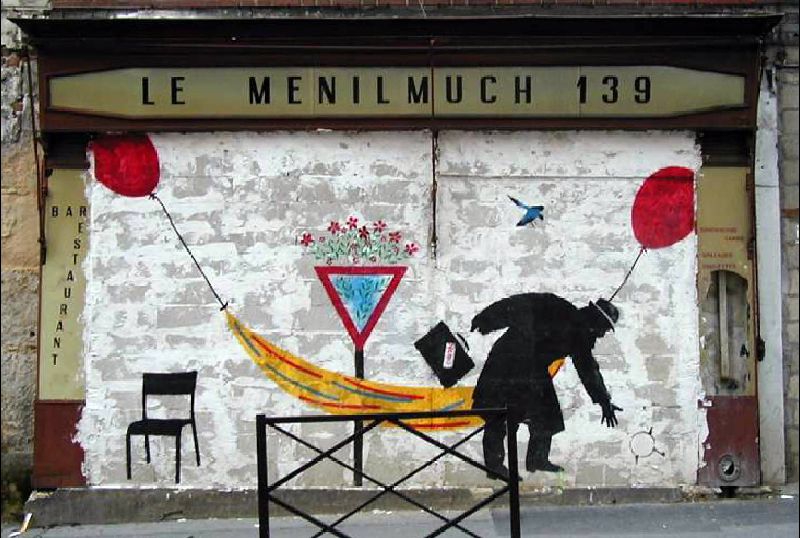
A singular figure of the first generation of French urban art, Nemo developed an instantly recognizable visual language from the 1980s onwards, defined by a remarkable economy of means. For nearly forty years, his black silhouette in a raincoat and hat roamed the walls of Paris and its suburbs, accompanied by a minimal repertoire of signs and objects — a red balloon, umbrella, suitcase, cat, birds or flowers. Far removed from any form of spectacle, Nemo turned the street into a realm of silent poetry, transforming the irregularities of the urban landscape into fragmented narratives.
Born Serge Faurie in 1947 in Masseret, Corrèze, Nemo first worked as a mathematics teacher and later as a computer specialist at a medical school, with no formal artistic training. He began working with stencils in the early 1980s in the Belleville and Ménilmontant neighbourhoods, just as a pioneering generation of street painters was emerging in Paris.
His pseudonym was borrowed from Little Nemo in Slumberland, Winsor McCay's landmark comic strip. His first interventions appeared along his son's route to school before gradually spreading throughout eastern Paris. The famous red balloon that frequently accompanies his character is a reference to Albert Lamorisse's eponymous 1956 film, shot in the streets of Belleville. Dreams, childhood and imagination were thus embedded in his work from the very beginning.
Nemo gradually developed a visual grammar of his own. A black silhouette, a few primary colours and a handful of recurring motifs were enough to evoke movement, waiting, travel or flight. His character walks, falls, sits or hangs suspended, using the particular features of each location as elements of the composition. Damaged walls, sealed doors, bricked-up windows, cracks and elements of street furniture become the setting for stories whose continuation is left to the imagination of the passer-by.
His work soon extended beyond the streets of Paris. Between 1996 and 2000, Nemo lived for several years in Colombia, where he created works in the streets of Bogotá and Medellín. In 1998, on the occasion of the FIFA World Cup, he was commissioned to produce a major series of murals in Seine-Saint-Denis, particularly around the Stade de France, in Saint-Denis and Bobigny. Some of these monumental interventions left a lasting mark on the urban landscape of the area.
From the 1990s onwards, Nemo also developed a long-standing artistic relationship with Jérôme Mesnager. The dialogue between Nemo's black figure and Mesnager's celebrated white Corps blanc gave rise to numerous collaborative works over the years. He also worked alongside Mosko and took part in events that accompanied the growing recognition of French urban art.
In 2006, writer Daniel Pennac devoted an entire book to his work, Nemo par Pennac, published by Hoëbeke. The encounter between literature and painting seems almost inevitable, given the importance of suggestion and storytelling in Nemo's work, as well as a territory particularly dear to both men: Belleville and Ménilmontant.
Nemo died in Paris in 2021, leaving behind a body of work deeply embedded in the visual memory of the French capital and its suburbs. With a silhouette, a handful of objects and a few colours, he developed a visual language like no other: an instantly recognizable form of urban poetry, capable of transforming the most ordinary walls into territories of the imagination.
In collaboration with Nemo's estate, Galerie Chenus Longhi is now undertaking an in-depth project dedicated to his work, with the aim of preserving his legacy, documenting its history and contributing to its recognition among the public, collectors and institutions.